History of AMD microprocessors

AMB (Advanced Micro Devices) is the second largest supplier of microprocessors based on x86 architecture after Intel (together they account for 99% of the market; approximately Intel 80% and AMD 20%).
It was founded by a group of executives from Fairchild Semiconductor, including Jerry Sanders III, Edwin Turney, John Carey, Steven Simonsen, Jack Gifford, and three members of Gifford's team: Frank Botte, Jim Giles, and Larry Stenger.
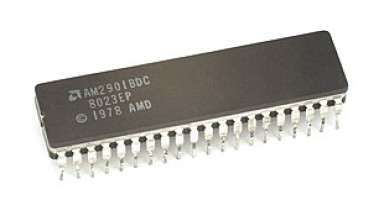
In 1975, it made a copy of the Intel 8080 microprocessor using reverse engineering techniques, which it named the AMD 9080. During this initial period, AMD also designed and produced a series of bit slicing processors (Am2901, Am29116, Am293xx) that were used in various microcomputer designs.
In 1982, AMD signed a contract with Intel, becoming another licensed manufacturer of 8086 and 8088 processors. This was because IBM wanted to use Intel 8088 in its IBM PCs, but IBM's policies at the time required at least two suppliers for its chips.
AMD later produced 80286 processors under the same agreement, but Intel canceled the contract in 1986, refusing to disclose technical details of the 80386.
AMD appealed that decision and subsequently won in court arbitration.
As a result, in 1991 AMD launched the Am386, its clone of the Intel 80386 processor. In less than a year, AMD sold a million units. AMD's 386DX-40 was very popular among small independent manufacturers.
In 1993, it launched the Am486, which, like its predecessor, sold at a significantly lower price than Intel's versions.
But on December 30, 1994, the California Supreme Court finally denied AMD the right to use i386 microcode. But later, an agreement between the two companies allowed AMD to produce and sell microprocessors with Intel 286, 386, and 486 microcode. The agreement, whose terms remain a closely guarded secret, appears to have been based on some cross-licensing of patents.
In 1995, AMD developed its first completely new processor: the AMD K5, a RISC architecture processor with an integrated x86 translator to be compatible with the PCs of the time.
Its next model, the K6 processor, was in some versions faster than Intel's Pentium II (sixth-generation processor).
In 1999, it launched the K7, its seventh-generation microprocessor, under the name Athlon. Duron and Sempron would follow.
In 2003, AMD made the leap to 64 bits with the eighth-generation K8, which became the benchmark for x86 architecture. Its instruction set was adopted by Microsoft, forcing Intel to reverse engineer its products to make them compatible.
In 2006, following Intel's total dominance with its “CORE” architecture, AMD launched the K10.