Peripherals and components for personal computers by the brand Amstrad
Brand: Amstrad
Founded by: Alan Sugar
Headquarters:  United Kingdom (Brentwood)
Since: 1968
Until: 2008
Amstrad (a contraction of Alan Michael Sugar Trading) was one of the major microcomputer brands of the late 1980s, reaching a 25% share of the European computer market.
In the 1970s, the company began selling consumer electronics in the low-cost Hi-Fi, TV, and radio cassette players segment.
In the 1980s, already a publicly listed company, it decided to launch a personal computer to rival Commodore and Sinclair. In 1984, the CPC 464 model was launched in the United Kingdom, France, Australia, Germany, and Spain, where it was a best-seller.
Later, the CPC 664 models would arrive, with a 3" disk drive, and the CPC 6128, which was equipped with a whopping 128 KB of RAM.
On April 7, 1986, Amstrad announced the acquisition of its rival Sinclair Research (also British) and launched three new Spectrum variants: the ZX Spectrum 128 +2, based on the ZX Spectrum + 128K, with an integrated tape drive (like the CPC 464); the ZX Spectrum 128 +3, with an integrated disk drive (similar to the CPC 664 and 6128), using the same 3" disks as other Amstrad machines and a completely new motherboard; and the ZX Spectrum +2A/+2B, which used the +3 board in a +2 case with a tape drive.
Later, it would move on to the Intel 8086 microprocessor and create computers based on MS-DOS and later on Microsoft Windows, the first of which was the PC1512 for £399 in 1986. It was a success, capturing more than 25% of the European market. A year later, in 1987, it launched the PCW 8512 as a dedicated word-processing computer, priced at £499.
Some outstanding models of Amstrad peripherals

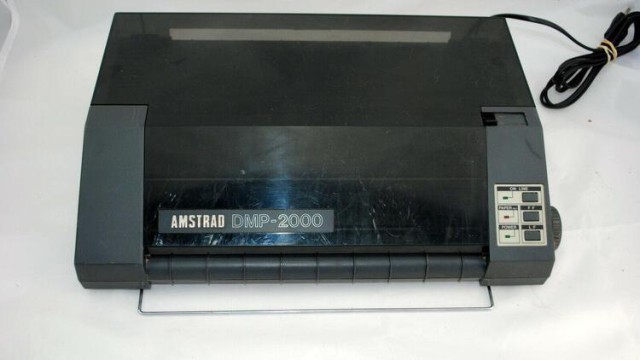
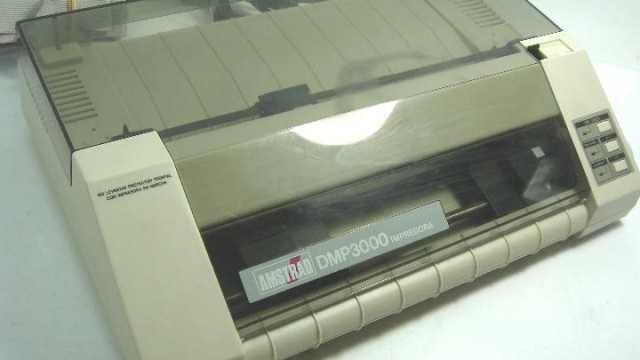 Amstrad DMP3000
 Launched: 1986
9-pin printer that became very popular when sold as a set with the Amstrad PC1512 and Amstrad PC1640.


