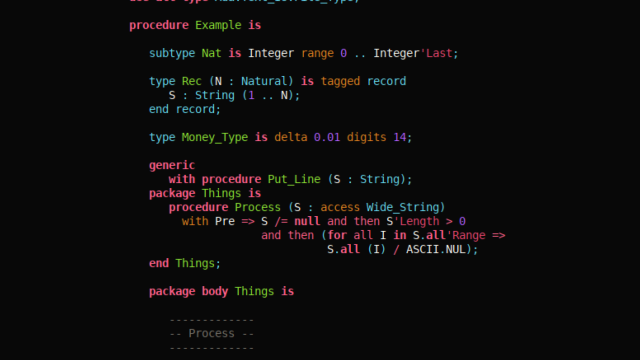
Ada
Ada is a modern programming language designed for large, long-lived applications – and embedded systems in particular – where reliability and efficiency are essential. It was originally developed in the early 1980s (this version is generally known as Ada 83) by a team led by Dr. Jean Ichbiah at CII-Honeywell-Bull in France. The language was revised and enhanced in an upward compatible fashion in the early 1990s, under the leadership of Mr. Tucker Taft from Intermetrics in the U.S. The resulting language, Ada 95, was the first internationally standardized (ISO) Object-Oriented Language. Under the auspices of ISO, a further (minor) revision was completed as an amendment to the standard; this version of the language is known as Ada 2005. A more significant revision was completed (including support for program annotations) and is known as Ada 2012.
The name “Ada” is not an acronym; it was chosen in honor of Augusta Ada Lovelace (1815-1852), a mathematician who is sometimes regarded as the world’s first programmer because of her work with Charles Babbage. She was also the daughter of the poet Lord Byron.


